Showing posts with label Derivatives. Show all posts

Thursday, February 12, 2015

Practice Makes Perfect

Learning math takes practice, lots of practice.  Just like running, it takes practice and dedication.    If you want to be really good at all types of math, you need to practice them all. You can't trust your innate natural talent to do most of the job for you.  There’s no such thing as math genes!


You must have heard this before, so let’s just do it.  Sign into Symbolab interactive practice (free of charge) and start practicing, it’s that simple (currently available for integrals and derivatives).

Practice:


Each subject is broken down into topics.   The topics are ordered by difficulty level (You can select a new topic any time).  Next to the topic we keep track of the number of problems you answered correctly.   We recommend completing at least 5 problems before moving to the next topic.   Start solving one by one.  If you need help click Next Hint (it will show you how many hints are still available).  When ready type in your answer, click Verify.  You should get instant indication if your answer is correct


If your answer is incorrect try again, ask for more hints.  Take your time, it’s meant for you to learn.


The Quiz:


At any time, you can test yourself by taking a quiz.  Simply select Quiz from the menu (there’s a quiz at the end of each level), click Start Quiz and go.  No hints this time, you will get your test summary at the end.

When to start? Now is as good a time as any…

Cheers,
Michal

Monday, February 24, 2014

Advanced Math Solutions – Derivative Calculator, Implicit Differentiation

We’ve covered methods and rules to differentiate functions of the form y=f(x), where y is explicitly defined as a function of x (click here to review explicit differentiation).  But what if we have to derive functions that are not set this way?  If you can easily express y as a function of x, by all means do that first.  For example x²+y=1, isolate y as a function of x:  y= (1-x²) and use the derivative rules.  Let’s look at x²+y²=1,  or y=sin(3x+4y), clearly isolating y is not trivial, this is where we’ll be using implicit differentiation;  Derive the left hand side and the right hand side with respect to x, and isolate y’.  It is basically an application of the chain rule, just remember that y is not a constant, it is a function of x.


Let’s see how it works (click here):


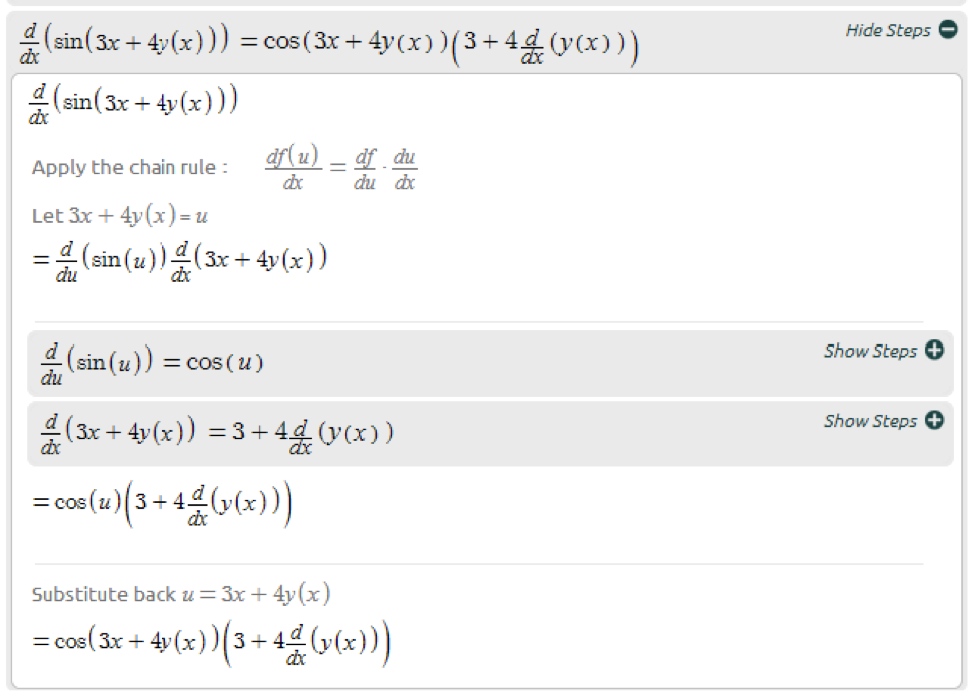
Now let’s take a closer look how to differentiate sin(3x+4y(x)) with respect to x:


Here’s another example, only this time differentiation with respect to y (click here):


Until next time,
Michal

Tuesday, January 21, 2014

High School Math Solutions – Derivative Calculator, the Chain Rule

In the previous posts we covered the basic derivative rules, trigonometric functions, logarithms and exponents (click here).  But we are still missing the most important rule dealing with compound functions, the chain rule.

Why is it so important?  Because most of the functions you will have to derive, and later integrate, are most likely compound.  For example sin(2x) is the composition of f(x)=sin(x) and g(x)=2x or √(x²-3x) is the composition of f(x)=√x and g(x)= x²-3x

The chain rule formula is as follows:  (f(g(x)))’=f’(g(x)) *g’(x)
That is, the derivative of the composition of two functions equals the derivative of the outer function times the derivative of the inner function


Let’s start with an example to see how it works (click here):


Here’s a more complex example involving multiple applications of the chain rule (click here):


With the chain rule we put it all together; you should be able to derive almost any function.  There are some advanced topics to cover including inverse trig functions, implicit differentiation, higher order derivatives, and partial derivatives, but that’s for later.

Until next time,
Michal

Friday, January 17, 2014

High School Math Solutions – Derivative Calculator, Logarithms & Exponents

In the previous post we covered trigonometric functions derivatives (click here). We can continue to logarithms and exponents.  The derivatives of the natural logarithm and natural exponential function are quite simple. The derivative of ln(x) is 1/x, and the derivative of ex is, ex.

From these, we can use the logarithms and exponents rules to differentiate the generalized form of logarithmic or exponential functions, or just get familiar with these four derivatives:

(ln(x))' = 1/x
(ex)' = ex
(ax)' = ax ln(a)
(loga(x))’ = 1/x ln(a)

Here’s how it works, (click here):


Here’s another example (click here):


Until next time,
Michal

Tuesday, January 14, 2014

High School Math Solutions – Derivative Calculator, Trigonometric Functions

In the previous posts we covered the basic algebraic derivative rules (click here to see previous post). But how can we derive trigonometric functions?  Simply by memorizing some common trig derivatives:

(sin(x))’ = cos(x)

(cos(x))’=-sin(x)

(tan(x))’=sec²(x)


Let’s start with an example, (click here):


Here’s another example (click here):


Until next time,
Michal

Tuesday, January 7, 2014

High School Math Solutions – Derivative Calculator, Products & Quotients

In the previous post we covered the basic derivative rules (click here to see previous post).  We are now going to step up a bit to differentiate products & quotients.  Functions involving products and quotients seem more complex, but once you follow the derivative rules it’s straightforward. Start by identifying the different components (i.e. multipliers and divisors), derive each component separately, carefully set the rule formula, and simplify.

Product rule:   (fg)’ = f’g + g’f

Quotient rule:  (f/g)'=(f'g+g'f)/g^2


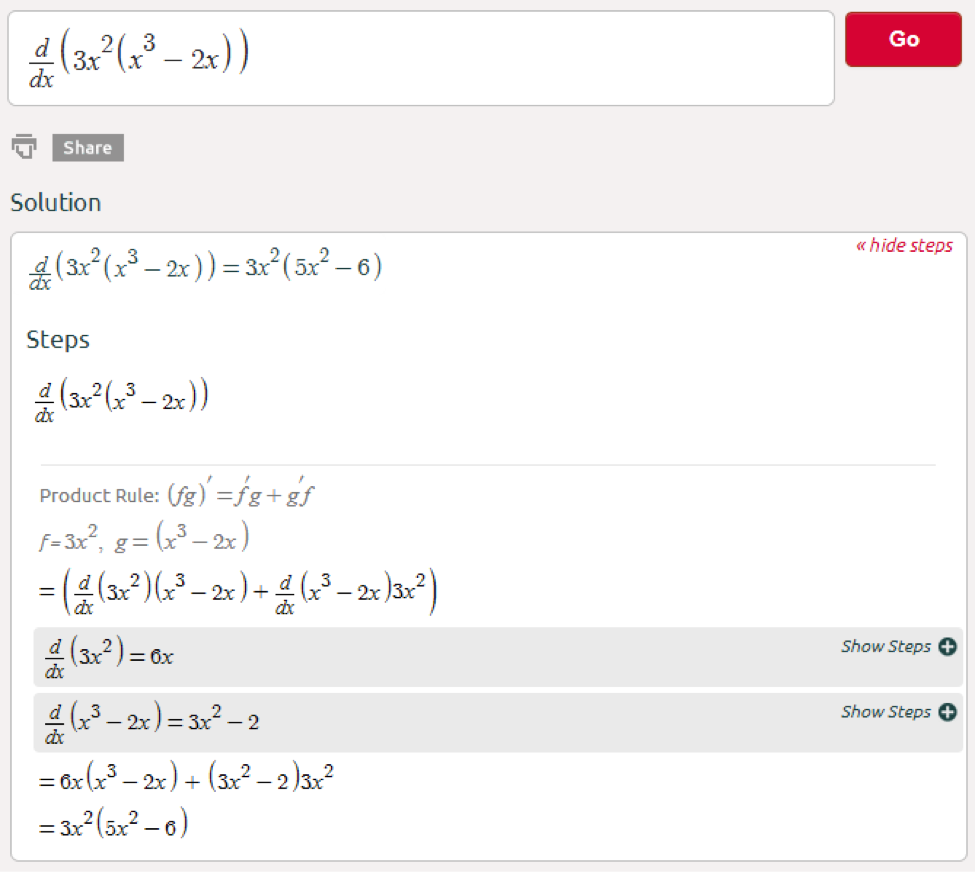
Let’s start with an example using the product rule, (click here):


Here’s an example using the quotient rule (click here):


Until next time,
Michal

Thursday, January 2, 2014

High School Math Solutions – Derivative Calculator, the Basics

Differentiation is a method to calculate the rate of change (or the slope at a point on the graph); we will not differentiate using the definition which requires some tricky work with limits; but instead we will use derivative rules that are fairly easy to memorize. We’ll start with the basics:

Constant:  (c)’=0
Power rule:  (xⁿ)’=nx^(n-1)
Multiplication by constant:  (cf(x))’=c(f(x))’
Sum/difference rule:  (f±g)’=f’± g’

We are good to go.

Let’s start with an example, click here to see how it works


Here’s another example (click here):


Until next time,
Michal

Wednesday, May 1, 2013

Symbolab Solutions, Your New Best Friend


You must have noticed that we are constantly adding step-by-step solution to help you with algebra and calculus (If not, make sure to follow us on Twitter @symbolab and Facebook)

So what’s new?  To make step-by-step solutions easy to access, we’ve created a new page, Symbolab Solutions, https://symbolab.com/solver  How simple?  As easy as it gets.  We’ve added a menu with a list of the topics, a compact pad with friendly must have symbols (if you’re math savvy, you might want to switch to the full pad), and examples per subject.

Simply select a topic from the menu, type in an equation using the pad or click on one of the examples… and Go.   You will get a step-by-step solution and a relevant plot just like that! 

For example (click here):


What else is new?  You can get Step-by-step solutions for System of linear equations, Factor quadratics, Expand, and Definite integrals.  Not only that, but also new and improved plots with an emphasis on the problem.

Check out this integral plot (click here):


Can your best friend do your math homework for you?  Didn’t think so, Symbolab Solutions can, just saying…

Cheers,
Michal