Showing posts with label Chain rule. Show all posts

Tuesday, July 21, 2015

Advanced Math Solutions – Limits Calculator, The Chain Rule


In our previous post, we talked about how to find the limit of a function using L'Hopital's rule. Another useful way to find the limit is the chain rule. When the chain rule comes to mind, we often think of the chain rule we use when deriving a function. However, the chain rule used to find the limit is different than the chain rule we use when deriving.

The Chain Rule:


What does the chain rule mean?

Given a function, f(g(x)), we set the inner function equal to g(x) and find the limit, b, as x approaches a. We then replace g(x) in f(g(x)) with u to get f(u). Using b, we find the limit, L, of f(u) as u approaches b. The limit of f(g(x)) as x approaches a is equal to L.

That sounds like a mouthful. Here we will go step by step for the first problem to better understand the chain rule (click here):

1. Find g(x) and f(u)


Since g(x) is the inner function, we set g(x)=\sin(x^2). We then replace the g(x) in f(g(x)) with u. Thus, f(u)=e^u.

2. Find the limit, b, of g(x)


3. Find the limit, L, of f(u)


We now get our answer:

Here is another example (click here):


Last example (click here):


Understanding the chain rule may be a little difficult, but once you practice some problems, which you can find on our website, the chain rule becomes much easier.

Until next time,

Leah

Monday, February 24, 2014

Advanced Math Solutions – Derivative Calculator, Implicit Differentiation

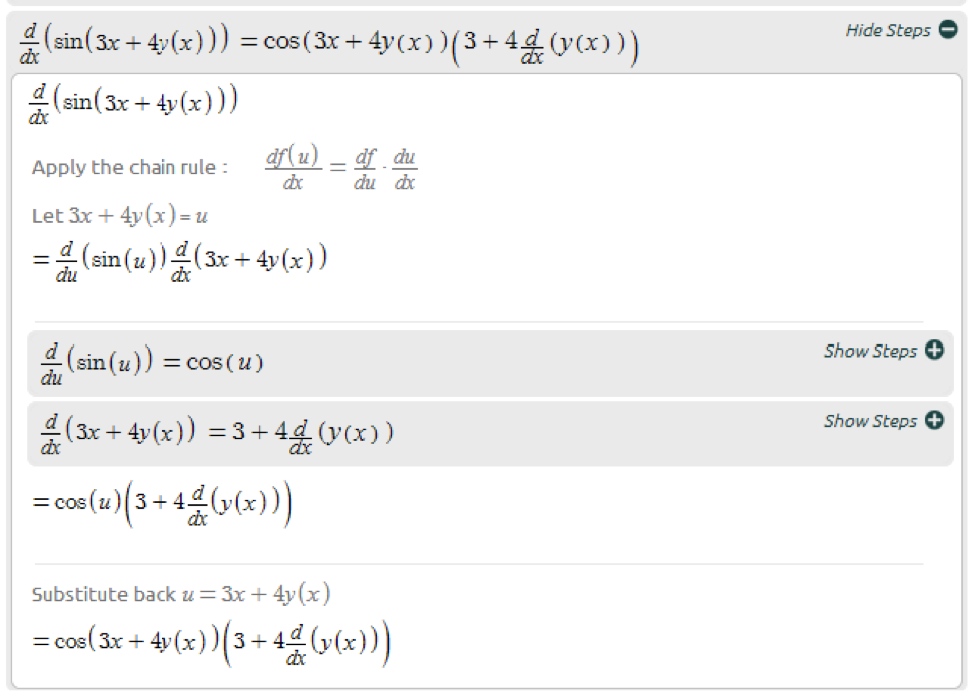
We’ve covered methods and rules to differentiate functions of the form y=f(x), where y is explicitly defined as a function of x (click here to review explicit differentiation).  But what if we have to derive functions that are not set this way?  If you can easily express y as a function of x, by all means do that first.  For example x²+y=1, isolate y as a function of x:  y= (1-x²) and use the derivative rules.  Let’s look at x²+y²=1,  or y=sin(3x+4y), clearly isolating y is not trivial, this is where we’ll be using implicit differentiation;  Derive the left hand side and the right hand side with respect to x, and isolate y’.  It is basically an application of the chain rule, just remember that y is not a constant, it is a function of x.


Let’s see how it works (click here):


Now let’s take a closer look how to differentiate sin(3x+4y(x)) with respect to x:


Here’s another example, only this time differentiation with respect to y (click here):


Until next time,
Michal

Tuesday, January 21, 2014

High School Math Solutions – Derivative Calculator, the Chain Rule

In the previous posts we covered the basic derivative rules, trigonometric functions, logarithms and exponents (click here).  But we are still missing the most important rule dealing with compound functions, the chain rule.

Why is it so important?  Because most of the functions you will have to derive, and later integrate, are most likely compound.  For example sin(2x) is the composition of f(x)=sin(x) and g(x)=2x or √(x²-3x) is the composition of f(x)=√x and g(x)= x²-3x

The chain rule formula is as follows:  (f(g(x)))’=f’(g(x)) *g’(x)
That is, the derivative of the composition of two functions equals the derivative of the outer function times the derivative of the inner function


Let’s start with an example to see how it works (click here):


Here’s a more complex example involving multiple applications of the chain rule (click here):


With the chain rule we put it all together; you should be able to derive almost any function.  There are some advanced topics to cover including inverse trig functions, implicit differentiation, higher order derivatives, and partial derivatives, but that’s for later.

Until next time,
Michal