Showing posts with label College. Show all posts

Tuesday, October 13, 2015

Advanced Math Solutions – Ordinary Differential Equations Calculator, Separable ODE

Last post, we talked about linear first order differential equations. In this post, we will talk about separable differential equations. A separable differential equation is a nonlinear first order differential equation that can be written in the form:

N(y)\frac{dy}{dx}=M(x)

A separable differential equation is separable if the variables can be separated. Separable differential equations are pretty simple and do not require many steps to solve.

How to solve separable differential equations:
  1. Rewrite the differential equation as N(y)dy=M(x)dx
  2. Integrate both sides
    • Don’t forget to add the unknown constant
  3. Solve for y(x)

We will solve the first example step by step (click here):

\frac{dy}{dx}=\frac{3x+1}{4y}

1. Rewrite the differential equation


2. Integrate both sides


3. Solve for y(x)


Here’s another example (click here):


Last example (click here):


I think separable differential equations are the easiest ordinary differential equations. There are very few steps to solve them and they are easy to remember. Memorize the steps and you’ll be good to go!

Until next time,

Leah


Wednesday, October 7, 2015

Advanced Math Solutions – Ordinary Differential Equations Calculator, Linear ODE

Ordinary differential equations can be a little tricky. In a previous post, we talked about a brief overview of ODEs. In this post, we will focus on a specific type of ODE, linear first order differential equations. A linear first order differential equation is an ODE that can be put in the form
\frac{dy}{dx}+p(x)y=q(x)

where p and q are continuous functions on a given interval.  In linear first order differential equations, we can derive a formula for the solution above.


How to solve a linear first order differential equation:
  1. Put the equation into form \frac{dy}{dx}+p(x)y=q(x)
    • This step is very important. You cannot solve, unless the equation is in this form.
  2. Set p(x)=(\ln(μ(x)))' and solve for μ(x)
    • μ(x) is known as the integrating factor
    • Integrate both sides
    • Don’t forget the unknown constant, c, and when you can combine multiple unknown constants
  3. Multiply the equation in Step 1 by μ(x) and simplify
  4. Use the product rule, f\cdot g^'+f^'\cdot g on the left side of the equation to make the left side of the equation equal to (μ(x)y(x))' and write it as that:
    μ(x)\frac{dy}{dx}+μ(x)p(x)y=μ(x)q(x)\quad\rightarrow\quad(μ(x)y(x))^'=μ(x)q(x)
  5. Integrate and solve for y(x)
    • Don’t forget the unknown constant and when you can combine multiple unknown 


We will go through this first example step by step (click here for a more detailed step by step): 

1. Put the equation in the form of a first order linear ODE


2. Solve for µ(x)

We integrate both sides to find µ(x).

3. Multiply by µ(x) and simplify

4. Make the left side equal to the product rule


5. Integrate and solve for y(x)


Here’s another example (click here):


Last example (click here):


Linear first order differential equations may look intimidating at first sight. These problems do take some time to solve, but are not very hard. The most important thing to remember is to not forget about the unknown constant, c.

Until next time,

Leah

Thursday, June 5, 2014

The Matrix, Inverse

For matrices there is no such thing as division, you can multiply but can’t divide.  Multiplying by the inverse matrix results in the same thing.    The inverse of a matrix A is A-1 only when:  A × A-1=  A-1 × A = I.   In other words multiplying a matrix by its inverse equals the identity matrix.

Finding the inverse of a 2x2 matrix is simple; there is a formula for that.  The bigger the matrix the bigger the problem.   There are two methods to find the inverse of a matrix: using minors or using elementary row operations (also called the Gauss-Jordan method), both methods are equally tedious.   We’ll be using the latter to find the inverse of matrices of order 3x3 or larger.   For a review of matrix elementary row operations click here.


This is one of the things you really want Symbolab to do the magic.

Here’s an example of a 2x2 matrix - click here:


I neglected to mention that the formula is using the determinant, Symbolab does that too:
(Click here for the link to the matrix determinant calculator)


Here’s a more advanced example with a 3x3 matrix - click here:


Let’s zoom into the row operations:


…told you it’s no fun

Here’s the link to an example with a 4x4 matrix, not for the weakhearted - click here.


Cheers,
Michal

Thursday, April 24, 2014

The Matrix… Symbolab Version

Matrix, the one with numbers, arranged with rows and columns, is extremely useful in most scientific fields.   There are a number of basic operations that can be applied to modify matrices such as matrix addition, scalar multiplication, matrix multiplication and transposition.  Solving matrices is not that bad once you get the hang of it, but, the larger the matrix the more tedious the calculation becomes.


Tedious?  not quite, let’s jump in and see how Symbolab can help you solve matrices.
To start with we’ve added easy to use buttons to type in matrices; this is how it looks like:


Matrices of the same size can be added or subtracted element by element.
Here’s an example (click here):


Not too complicated, just takes a lot of work

Two matrices can be multiplied only when the number of columns in the first equals the number of rows in the second.  If A is an m-by-n matrix and B is an n-by-p matrix, then their matrix product AB is the m-by-p matrix whose entries are given by dot product of the corresponding row of A and the corresponding column of B.

To make this simple, let’s take a look at an example (click here):


Multiplying matrices is no fun…

To transpose a matrix simply swap the rows and columns
Here’s an example (click here):


The trace of an n-by-n square matrix is defined to be the sum of the elements on the main diagonal
Here’s an example (click here):


Matrix takes practice, click here to start.

Cheers,
Michal

Thursday, March 20, 2014

It’s A Small World

Mathematics is a language; it is the language of science. Our vision, when we started this journey more than two years ago, was to make scientific content universally accessible by expanding the searchable space onto scientific notations, expressions, equations and formulas.  So we’ve built a search engine that does just that.  But for kids to learn math, first and foremost they need help with their class work, they need help solving problems, they need help now.  So we’ve built step by step solutions engine that can solve any math problem to complement the search.  The response is amazing, school kids and college students love Symbolab, not because they can “cheat” with their homework, but because they can finally understand math.


To be really helpful, we are now making the solution steps available in multiple languages.
The world is not so small after all…we are doing this step-by-step, starting with calculus solution steps in Chinese and Russian.

Here’s the link to Symbolab Solutions in Simplified Chinese: http://zs.symbolab.com/solver


Here’s the link to Symbolab Solutions in Russian:  http://ru.symbolab.com/solver


Stay tuned for updates

Cheers,
Michal

Monday, February 24, 2014

Advanced Math Solutions – Derivative Calculator, Implicit Differentiation

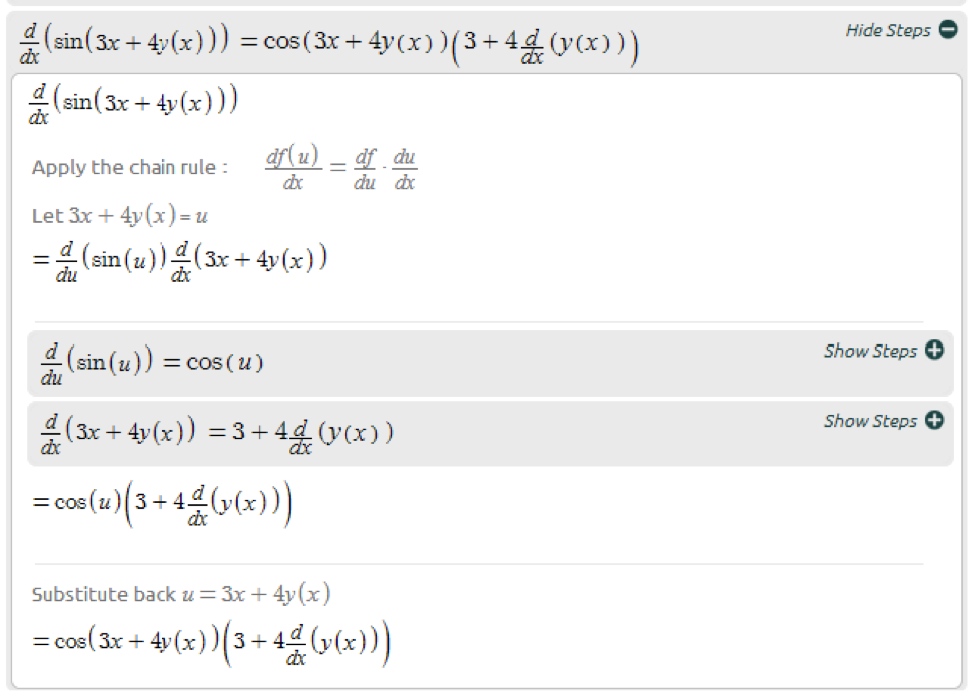
We’ve covered methods and rules to differentiate functions of the form y=f(x), where y is explicitly defined as a function of x (click here to review explicit differentiation).  But what if we have to derive functions that are not set this way?  If you can easily express y as a function of x, by all means do that first.  For example x²+y=1, isolate y as a function of x:  y= (1-x²) and use the derivative rules.  Let’s look at x²+y²=1,  or y=sin(3x+4y), clearly isolating y is not trivial, this is where we’ll be using implicit differentiation;  Derive the left hand side and the right hand side with respect to x, and isolate y’.  It is basically an application of the chain rule, just remember that y is not a constant, it is a function of x.


Let’s see how it works (click here):


Now let’s take a closer look how to differentiate sin(3x+4y(x)) with respect to x:


Here’s another example, only this time differentiation with respect to y (click here):


Until next time,
Michal